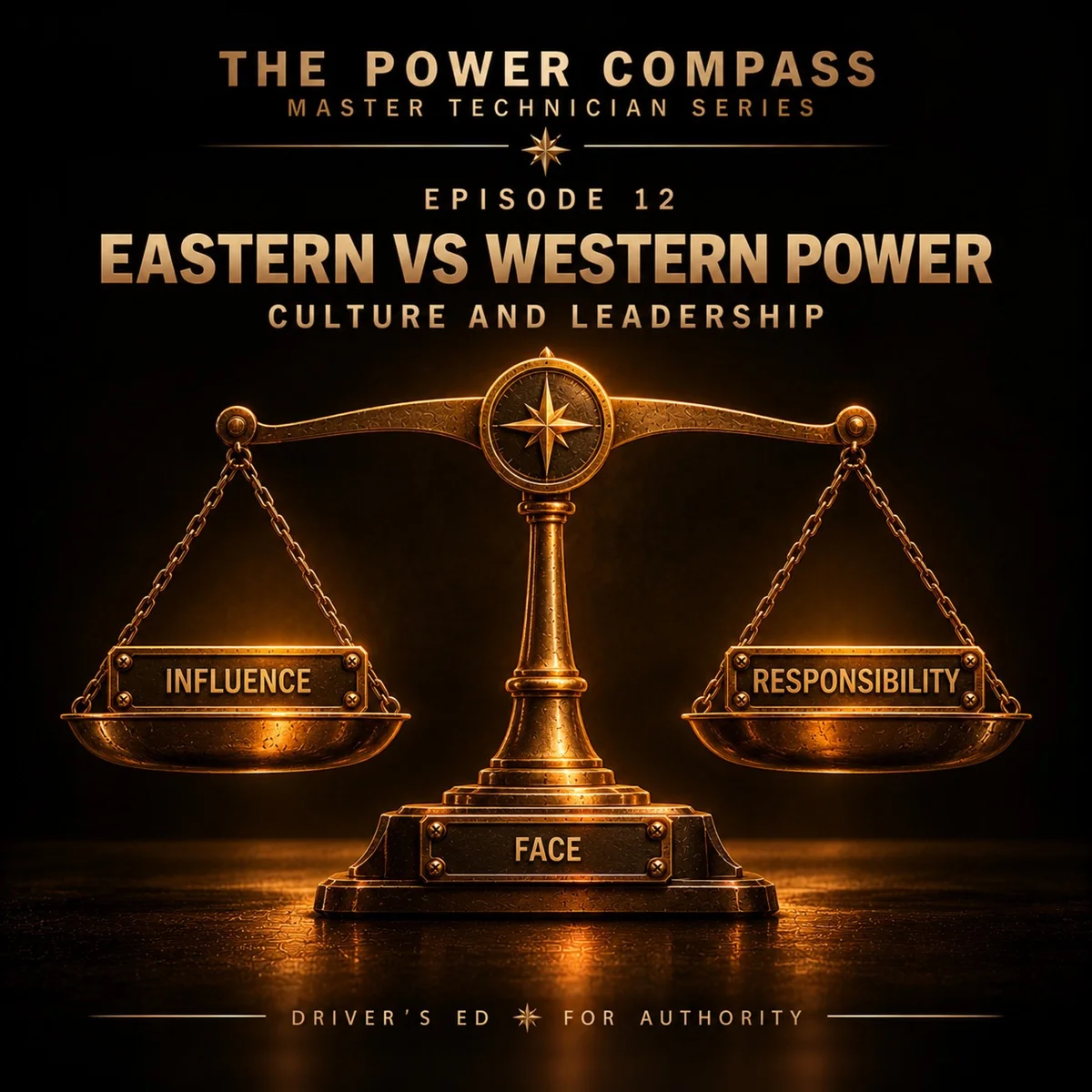
Eastern vs Western Power | Culture and Leadership
Is power influence or responsibility? How guanxi, face, and philosophy shape power differently in East and West.
- Western power as influence vs. Eastern power as responsibility and restraint
- The philosophical roots: Nietzsche's will to power vs. Lao Tzu's power through restraint
- Guanxi — the deep, reciprocal relational power built over years, not networking
- Face — why protecting status shapes nearly every interaction in Chinese business
- A real story of a Western-style negotiation that stalled for a year
- Positional power vs. relational power, and why one lasts longer than the other
- Practical cues for reading high power-distance cultures without causing offence
Drs. Vinay and Paul contrast Western notions of power — built on individual influence and rights — with Eastern, particularly Chinese, notions rooted in responsibility and restraint. They trace the philosophical roots (Nietzsche's will to power vs. Lao Tzu's power through restraint) and unpack two central concepts: guanxi, the deep, reciprocal relational power built through long-term obligation and gift-giving, and face, the socially constructed status that Chinese leaders must protect for themselves and others. Personal stories — a frustrating cross-cultural business negotiation, a gift that took a year of relationship-building to earn — illustrate why Western directness can be read as aggression, and why relational power often outlasts positional power.
01Welcome and Episode Overview: East vs. West Power Dynamics
00:00:0002Defining Power: Western Influence vs. Eastern Responsibility
00:00:2503Confucian Roots and Political Perspectives on Power
00:04:4904Cross-Cultural Business Challenges and Relationship Building
00:06:0805Philosophical Foundations: Nietzsche, Lao Tzu, and Power Distance
00:11:0306Guanxi Unpacked: Beyond Networking to Deep Mutual Obligation
00:17:2307Face and Status: Navigating Social Harmony and Conflict
00:24:5908Reflections and Takeaways: Applying Power Literacy in Practice
00:36:13Auto-generated transcript (speech-to-text). Speaker labels not included; minor transcription errors may be present.
So, welcome everyone to our next episode. Me Dr Stephen Agatha my friend and colleague dr Paul Donovan discussing all things power. And today we've got a very interesting episode for you. We're talking about Eastern and Western Power and contrasting them. I mean this is a very fascinating Very broad very deep topic. Today were gonna introduce you some of the key ideas. Yeah, I mean in future episodes we might go into this in more depth. but today We want to outline to you some of the key points about what are the differences and if any of You are operating an across cultural context a multinational company or a multinacional Contacts working with other cultures.
This kind of awareness is very important. So without further ado let's just get straight into it, we're going to look at the issue of particularly Chinese culture and what's called Guangxi. And the kind of cultural nuances...the differences between the lenses that an Eastern in this case, particularly Chinese point-of view of power, power in business and a Western point of view. so where should we start? Well, let's start with power.
You know I love the way you say that all things power there is no doubt about it what we are focusing on really playing between two of us and how to use power better or be more power aware? How do manage others in their use of power? We see this as a critical competency for personal effectiveness and leadership. conceptualizations of power and compare that to Chinese conceptualization. So, Vinay I'll start with a really broad overview by saying just two phrases. so in Western cultures powers often conceptualized around how much influence you have How much freedom do satisfy your own desires?
How much power over the allocation resources for instance. And that's how we naturally think about power in a Western context. now, In the Eastern Context it is little different. and because there well maybe you might say more than a little could be very different. Because the tendency here to think of Power as bringing with responsibility and restraint. so thats'a very interesting polarity between the western notions of power and how it's conceptualized. how to bring and the notion that if you have power, then you basically large responsibility.
And your job is do exercise restraint? Of course it's not everything about power being. we'll talk later on about the high distance low-distance notion and criticality of bearing responsibility for people over whom may have power. but thats part conceptualization of it, and really looks to flood into an informed lot-of-it day-to-day interactions even if we don't know. Even people haven't given a language. there's language to explain some the deep influences that have in West or East Asia or China. do you any comments on this?
Sure. Well, there's a few things. firstly the Chinese Orientation we're talking about is obviously based in Confucianism and These ideas which are very old and very deeply embedded in their culture And even despite for instance cultural revolution Those ideas you know They still kind of been the blood and they've got to be revived even by that current Chinese government. So we're talking about thousands of years old tradition. and also what's interesting on a kind of political level is that the western talk, politically liberal democracies which we champion especially based in The Notion Of Rights across from US. you have A Bill you know Western countries are very concerned about human rights and justifiably so.
On the other hand, um other countries in other places including China uh less focused on rights and they're actually more focused on a sense of responsibilities that the state has and responsibilities that people have towards each other and back to the State. So this is like a different conceptualization Actually of political power. And then we're going to talk kind of business level. So this is the wider frame of understanding these differences and they're very interesting because that there are indeed in many ways philosophical differences, they pan out in behaviors but their kinda much more deeper than simply observing those behavioral difference.
Yes! They have a long history and a deep well from which they come. But as you said, they inform business and ultimately get visible through behaviors most notably by the way we interact with each other. so here comes the problem really. when leaders are working cross borders They'll bring their power defaults So they'll bring their tendencies without realising that there may be a kind of attention between the way they behave and other people from another culture.
For instance, Western manager or leader in their natural default means Be powerful to come across as having power may find themselves being quite direct and be experienced. As aggressive Because they've misread. They're assumed that they have the relationship in place To be very direct But as we'll discuss in a few minutes Relationship building is especially important within China And it's a nuanced Set of activities, and it takes time.
But the western business leader may think that we've got sufficient relationship for me to be very direct, but in actual fact they're being experienced as aggressive and I might not know it. I'll give you an example of that... Yeah! The third tier city is called Zhengzhou although it was originally one of the capitals of China. but these days, It's certainly not in the center. And they organize workshops for me. so They're very good company and very good people.
I work with an excellent liaison person and i really appreciate her a lot Like for instance six months now been trying to negotiate with her, with the company adding another kind of type of workshop. And it's very frustrating for me because we're going to talk about it and then you know she gets... It doesn't seem to move forward. I get a bit frustrated with it. so my approach Western approach is just be direct. okay what does that need do? make this thing happening?
What are the obstacles? as a presenter who comes in and has seniority, things like that. So I kind of expect okay you know it's gonna happen its not going to happen. what are the arrangements? And then there is just this sort of foggy response. from my point-of view and clearly it's cultural thing because i'm really reading The Field My wife says oh...you need be more appreciative And she's Chinese, right? Yes. Oh yes there is a Chinese company and she speaks in English which I appreciate. but the company yeah very very Chinese.
Yeah our sort of dish dog company...and my wife says no we need to be sending her some gifts. you know just not handling it correctly clearly. But if this was my western directness then nothings gonna happen. I'm missing something, so it's an example of what we're talking about. Yeah! It is. and now that you've said that your reminded me because i have done a lot work in one Asian country called Singapore which has the number of Asian influences there. but do remember when started my work where met this particular contact from civil service organization that runs hundreds of programs for civil servants there.
It's a college in fact and we started off, she saw me present an England at conference. so she contacted but then to my surprise we exchanged emails just gently for the next twelve months now not I was thankfully busy doing other things. i didn't really mind oh my god it. And I really thought nothing would come from this, because it was just petering into nothing. And then twelve months later she said yeah we're ready now!
Come on over and let's do your first pilot alright? Okay great you know...and so since then i would have run probably thirty programs like..I ran one over there that I ran another ..and they got to know me. ...then I ran a lot....because the relationship is built. But to my surprise, twelve months of just tic-tac'ing back and forth. And then they went into work mode! It was incredible...and the organisation around all of my work was INCREDIBLE!
IMPECCABLE! Just impeccable arrangements. but there is a relationship process happening that i did not appreciate.. ..and thought it's going in nothing But something clicked over, you know. Well that's the thing isn't it? We're talking about relational power and also face. we'll be discussing face in its relationship to status. but indeed these are core concepts And perhaps we can move on some of the philosophical underpinnings because I did mention this long history In for instance contrast Nietzsche significant philosophers, Eastern and Western.
Lao Tzu was a lot longer ago but nevertheless they're very influential in the two traditions. And so the western tradition. you know Nietzsche can all imagine that Uber mentioned this notion of the striving to power Fascinating as Westerners were fascinated. I love Nietzsche, you know he's such an interesting character and his writing is so interesting And it really represents this sort of assertiveness taking assertive action meeting your individual goals that the western tradition bold summarises.
That's right! Exactly. On the other hand we have Lao Tzu Daotie Ching and the notion of way, action non-action. And conquering through inaction is not really inaction but it's hard to translate. so that suggests actually power isn't restraint. The restraint of your will rather than exercise. if you'll will produce completely different orientations. what powers we should do with them? Yeah, yeah. Thank you for raising those two philosophical beds from which these conceptualizations of power have come and more recently their experience I suppose in what authors are called high power distance, you know that China is a high-power distance.
That it's hierarchical and there's significant difference between those above or below rather than in Western. they're always looking to shrink the difference if possible. and at low, low distance. Well in China it's high-distance but this does not mean that the leader of China is necessarily just there to dictate. so its... It does means there is an orientation from below to obey, but that also built into responsibility and restraint.
I must act in a way considerate for the people beneath me so as bring social harmony within my world of exercising power. part of what happens in high-distance, power distance cultures as China is. Is there's an attendency to look up some distance obey but a greater sense of responsibility felt from above? Exactly and this something that again just coded political level. for the moment I think most Westerners don't understand about China. they use this or call it easy term its totalitarian regime really describe what it is, yes there's very vertical power and the state certainly exercises its power.
There's no doubt. but it's not just tanks rolling in. of course they have been instances where tanks are rolled-in and there has been a heavy handed use for power. But my observation living here that isn't how things work relational and it is very based on responsibility. And from what I can see, the Chinese government feels quite a lot of responsibility to its citizens in terms of their well-being and their welfare. that's really considered in decisions quite a Lot.
That maybe isn't always transparent to Western observers but here i Can see that? It's evident In A lot Of Government Decisions. even for instance you know government will decide okay we're going build a city of fifty thousand people there on that farmland. and you know in the west, you can just imagine the years of negotiation and consultation. And here the government's like okay we're going to do it next year. so they have to clear their farms off the land which is a big dislocation. but what interesting They compensate the farmers quite well.
In fact, some farmers kind of wait for that to happen because you know they get an apartment For each family member in the town and You know there's really a sense of kind of mutual responsibility in The process. it's not just a heavy-handed government coming in. so That's a political level political social level Coming down to the business level which is what we're especially focusing on um? That's also true. It's not always apparent because it looks like the big power Difference means that someone can just roll in and make heavy-handed decisions.
But when you have this network of the sense of power's responsibility, And a mutual obligation which is very much embedded In Confucian ideas then indeed it produces A social framework That has these respectful attitudes built into It. Thank You for that! Perhaps very helpful For some people who are thinking or who are already engaging with Chinese colleagues, business partners not to just blanket the Chinese culture as totalitarian.
There's nuance in here and it is actually not that way. everyone lives day-to-day. you can do business there. certainly has said. government may have very heavy handed things from time to time, but most Chinese citizens are living in the day-to-day just getting their job done. Just fulfilling their obligations. family business and that's what if you want it do business at. That's What You'll Need To Understand you know?
And so is to be able to make sense of your everyday interactions. So perhaps we should go to this guanji. Let's talk about that. Yeah, you know like some people have a related guanji to notions of Western networking. But it's a lot deeper than that right? It's if there is large deep or kind of relational dynamic happening then yeah the networking piece No way way deeper than mad. its bit more I don't know, to use it not quite correct but its a bit more like the mafia.
You know? These deeply embedded family relationships and mutual obligations And who owes whom? what? Not just suggest that Chinese business is liked up But has kind of quality Networking just doesn't describe it in any way. and you're describing the year lead up. That's an example. It's its relational power, but it's built on mutual obligation And certainly long-term commitments and very much reciprocal social exchanges. so gift giving is certainly a part of that. and there some My wife was telling me like There's a thing here when people get married especially young People The You know people come to the wedding and they'll give them a red envelope So it's got money in.
So yeah, that's the main form of kind of gift-giving that occurs. And then what happens is like to... Like parents or something will take a careful note of everybody and how much they gave and it goes on like a register! Then there's this obligation over time To give their money back. as successful Each amount has to be given back. So there's a thing here, it is the phrase which says thank you for not inviting me to your wedding because if you invite someone into their wedding then they kind of do this whole gift thing and that gets embedded in them.
That's interesting! So yeah, that's an example of long-term obligation. Yeah and it speaks to the typical nature of these social exchanges. you're referring too but The Long Term Commitment And Of course there is a relationship between Ganji then and building this relational power This capacity To build relationships. where reciprocity Is experience where there's sufficient relational power, you can then leverage it or at least ask for things that you might be more likely to gain back when they're sufficient.
I mean Stephen Covey talked about this as a metaphor of having a bank account between two people and the bank account represents the level. That notion, as lovely as Stephen Covey's notions are after all these years. It doesn't only goes very much partway to explain the depth of Guangxi and the richness of this centuries-long tradition of building relational connection as every most people listening to this will know that the often in Western societies is a distinction between relational power and positional power.
And so it's very important to know their difference because relational power requires this acceptance, this familiarity... ...and its built through relationship over time where you can have positional by doing nothing at all other than just being given the role. And it's asymmetric, someone has positional power and another person doesn't. Now there is something... What are you going to mention? Excuse me Yeah with a positional situation in Western Tower There also some kind of ethical values around it that you know, You need some kind of separation and maybe don't have lunch with the staff.
And there's a hierarchical division. It is reinforced Whereas the Chinese notion is very different. Like, you're a boss but yeah... not only have lunch with your employees But one of my women that I interviewed Very interesting interview for my PhD at Chinese woman. She was like Yeah! In fact she said..I asked some of my employees to do things personally For me and personal life And they can say no, that's perfectly fine.
She said but it's good if they do that because then It builds our relationships. I mean in a western context. you know That this is completely beyond the pale. there would be like an abuse of power. Yeah. But she was like yeah You don't know what's a good thing. and Then their loyal to me and i'm loyal To them and she even gave An example where? She moved her but she moved to A different workplace And she just took Her stuff with her.
Like they're all loyal to her. Yeah, the whole staff that just went with it. So you know That's relational power. yeah most bosses dream of that kind of pool. You know what I mean? But if interesting, you know like yeah and to be able to just we call that in you Know in power use language The notion up. hey can you just pick out my dry cleaning on your way to work? We'd call that highly indulgent You know, but it might be experiences a little differently presumably in a Chinese context where It's seen as personal. and And if you do that for me then you can guarantee I'll do something For you.
Yeah at this or least In a healthy relationship? You Know. so Yeah fascinating. So yeah, there is very different conceptualization of it you know, and in terms of this positional and relational power. And it does mean that this notion for instance giving gifts can be a very legitimate means of building relational power but its'a personal thing. thats not often done like the western culture You know? I remember when your beautiful wife was staying at our place over here in Australia.
Your wife left out beautiful gift, this incredibly beautiful Chinese teapot with cups. And we love taking that out and using it you know? It reminds us of you guys! We were quite blown away by that. right Vinay like...we just weren't expecting a gift. You'd stated our house but no one leaves us gifts. Not not quite like that, you know. someone might buy us a candle which we love but there was a different quality to this gift Which struck us as uniquely Chinese in its and it was touching.
It was really touching And yeah so it's uh So okay? So then we go. can we move from Guanzhi onto the notion of face? Yeah because You Know This what you know. That face is really, and about losing face. Is a really critical experience to be avoided And in Chinese culture they've named it. They called it Face. Lots of Western culture has picked that up But its such crucial feature that Chinese managers must maintain face, and those underneath them look to avoid their boss losing face.
And because that's just a critical lack of social status... So let's talk about the difference between status in power which is defined now? Because status and face are sort related different terms, but they're kind of connected together. So how would you define the difference between the two? Well this face...this experience is a socially percepted construct. it's to the ability which others are admired or respected and so its subjectively experienced.
Now, there is a power in that. So if someone has a lot of social ranking or status and face then it's really useful to know you've got and are responsible when doing something wholesome because it gives your influence And you can lead people and they more likely follow if there's got that. That is quite different to being the boss, which has having this position or power assigned by your role. but I've recently been dealing with a boss who had He had this status.
There was no doubt he was the boss, but he had weak relationships with those in his team and over time His it was wearing thin. so while they did well The team did the bare essentials. there wasn't a lot of over and above. There was not a lot of day-to-day engagement, And interestingly there is one member who had a lot social status in that team. She has gone to the trouble building relationships with each and every one of her fellow team members. she also experienced incompetent.
So we have one person who had hierarchy positional status. We've got another person on our team Who had alot of social status in the team. This boss intuitively knew that if he didn't get this particular woman who had socials on board, then it was kind of sunk. He was kind of sunk and that became. the work Of this leader is to build relationships at least with this one person who has all his social rank in In The team, and it's a different kind of power. but for this boss, who had the hierarchy or positional power truly needed to build relationship with one that has social.
And I'm all of a time supporting leaders and building more social relational powers in their teams where they can match the hierarchy with the relational thing connected to face things. The faces connect with status, these concepts and they're describing similar faces are very significant cultural features you say and I think Chinese managers therefore have a lot better, particularly kind of understanding the relationship between status and power because face is so important as you say.
And part dictates a kind of communication style, which is less confrontive in many ways. So there's more this emphasis on what they call harmonization and rather than dealing with things head-on direct disagreement or putting someone on the spot strips them up Face and therefore status, and they're for kind of ruins the relationship. so there's a sensitivity There that one you are trying to develop it. That tends To be a bit more inherent in The culture. yeah It is a bit More inherent In the culture.
Of course like all strengths It can become problematic if the boss Is over its experience as being conflict Averse You know. And just because a Boss may Be very aware of face, doesn't necessarily mean they'll be conflict-averse. but that may have a natural tendency if not well trained to avoid important topics. That actually really do need to be discussed. Yeah and an example is with the previous husband like twenty five years ago my wife ran in number businesses. this was in the late nineties, early two-thousands.
And they ran a number of businesses and China like manufacturing luxury sort of clothing and things like that for the West.". She said sometimes they'd have these contracts with factories harraining the factory because they were falling behind and The factor it say yes. Yes, you know we'll have a tomorrow And then like weeks later It wasn't happening. so that's her husband at the time went in went to the factory went to this countryside.
They hadn't even started production You know, they just had to save face. They couldn't be direct and so obviously that creates all sorts of problems when you get too much indirectness and Too much preservation of faiths And then also can ruin a business. Yeah situation yeah. That's Just So Fascinating and that's an extreme example but A very good one. Then You know, the father of most organizational development work is considered to be a Harvard professor by name Chris Argus and he was someone who looked specifically at what's called undiscussable topics.
But that primary driver of topics which became undiscusable were saying things that could cause embarrassment and it seemed to present a kind of psychological threat, one kind or another. And that's where I started thinking this sphere was a much bigger deal in the West than is usually discussed. Because while it creates undiscussable topics, the issue of embarrassment itself isn't discussed whereas its more keenly understood because they acknowledge it to be big factor influencing our interactions.
It's just that Western culture you could say perhaps it might not be quite as large a factor. Truthfully, its' not even talked about in the way that needs to be discussed because is much bigger than what Western cultures acknowledge and so just Chinese culture have more language Exactly. But it's a big issue because this fear of embarrassment is what actually drives the majority of subjects in teams that are working, it drives them underground.
Yeah and I mean...this is very big topic. we're going to finish soon so i can't dive into it..I do want make a segue though too What you describing embarrassment connected with shame. And shames have been significant topic in the arena of psychology and relationships because when we're too exposed, and we experience shame. We lose faiths in a Chinese sense then our functioning goes down. actually all sorts of physiological and psychological correlates are there And there's all sort of problems which occur in relationship Because it's undiscussable and usually gets tucked away so that can shame other people.
It can lead to very vicious cycles and traumatic experiences which are quite formative. So yes, I agree with you even though it's not necessarily discussed or acknowledged. so much is very much a driving force and in this sense we can learn something from the Chinese understanding. being here sometimes seems to me that they're little bit too focused on status, you know that's my Western judgment. Oh My God! It is so important to them and yet in a way it probably just acknowledging something we kind of hold anyway within ourselves. the book on status recently written in The West by an American author and he reckons that it is actually one of these significant shapers, almost every interaction.
It's to who has got status? Who have less than how can I get more? Very interesting. That would be great! Eric Stoltz his name was not put into a link but goes too saying we are much more oriented towards face & status. then in the west where really acknowledged In the East, they acknowledge it and talk about more in the West perhaps more than we think. And so that's been a very interesting read. The front of his book is really interesting because he has put by best-selling author and then small name... ...and whole front to be ironic Because its an expression status.
It's clever. So, so here we are this great and I hope our listeners gaining some insight an understanding around power. And the differences in expression in a Western or Chinese or East Asian experience? In particular round this notion of influence on the one hand and restrain your responsibility in other. And then these two ideas of Ganji, this relational power... Quan Chi! Quan Chi sorry thank you! The other notion of face losing social status or gaining social status. very interesting ideas right?
Yeah we can ask listeners to as we started to do, reflect on this yourself in your own life and experiences. Your business dealings... In whatever form that is. looking at what's happening with the relational dynamic If you look away from just a positional issue then What Is Going On With This? Building A Mutual Trust As You Say In That Example Of The Boss And The Woman With Social Status? These Things Are Actually essential to pay attention too.
So when you might go and make a request or something of someone with power, maybe reflect on this? Yes exactly we'd love it to reflect on that! And build your literacy of Power When You Do...and thats what will happen as you reflect. Thanks everybody. Okay thank-you see ya next time.